

What is the elongation at break of Fluorosilicone Rubber?
Elongation at break is a critical mechanical property that measures the maximum amount of strain a material can withstand before it fractures. In the context of Fluorosilicone Rubber, understanding this characteristic is essential for both manufacturers and end - users. As a Fluorosilicone Rubber supplier, I am well - versed in the nuances of this material, and I'm excited to share in - depth knowledge about its elongation at break.
Understanding Elongation at Break
Elongation at break, often expressed as a percentage, represents the ratio of the increase in length of a specimen at the moment of rupture to its original length. For Fluorosilicone Rubber, this property is a key indicator of its flexibility and toughness. A higher elongation at break generally implies that the rubber can stretch more before breaking, which is highly desirable in many applications.
When we test the elongation at break of Fluorosilicone Rubber, we typically use a standard test method, such as ASTM D412. This involves preparing a dumbbell - shaped specimen of the rubber and then pulling it at a constant rate until it breaks. During the test, the testing machine records the force applied and the corresponding elongation of the specimen. The elongation at break is then calculated based on the final and initial lengths of the specimen.
Factors Affecting the Elongation at Break of Fluorosilicone Rubber
Chemical Composition
The chemical structure of Fluorosilicone Rubber plays a significant role in determining its elongation at break. Fluorosilicone Rubber is a copolymer composed of silicon - oxygen backbones with fluorinated side groups. The presence of fluorine atoms enhances the rubber's resistance to chemicals, oils, and high temperatures. However, the degree of fluorination and the type of cross - linking agents used during the vulcanization process can affect the rubber's molecular mobility and, consequently, its elongation at break. For example, a higher degree of cross - linking generally leads to a lower elongation at break because the cross - links restrict the movement of polymer chains.
Temperature
Temperature has a profound impact on the mechanical properties of Fluorosilicone Rubber, including its elongation at break. At low temperatures, the rubber becomes stiffer, and its elongation at break decreases. This is because the polymer chains have less mobility at lower temperatures, making it more difficult for them to stretch. On the other hand, at high temperatures, the rubber becomes more flexible, and its elongation at break increases. However, if the temperature is too high, the rubber may start to degrade, which can also negatively affect its mechanical properties.
Additives
Additives are often used in Fluorosilicone Rubber to improve its performance. Fillers, such as silica and carbon black, can enhance the rubber's strength and hardness but may reduce its elongation at break. Plasticizers, on the other hand, can increase the rubber's flexibility and elongation at break by reducing the intermolecular forces between polymer chains. However, the type and amount of additives need to be carefully selected to achieve the desired balance between different properties.
Importance of Elongation at Break in Applications
Sealing Applications
In sealing applications, such as O - rings and gaskets, a high elongation at break is crucial. Seals need to be able to conform to irregular surfaces and withstand deformation without breaking. Fluorosilicone Rubber with a high elongation at break can better adapt to the shape of the mating surfaces, providing a more reliable seal. For example, in automotive engines, where there are high - temperature and high - pressure conditions, Fluorosilicone Rubber seals with good elongation at break can prevent leakage of fluids and gases.
Fluorosilicone Rubber Umbrella Valve
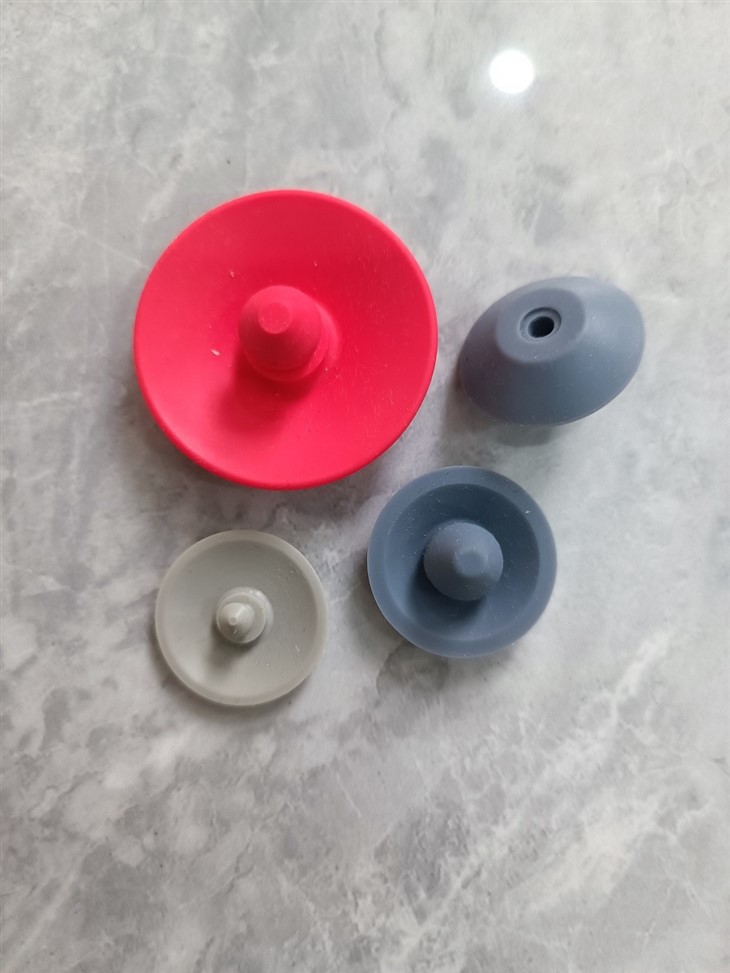
Umbrella valves made from Fluorosilicone Rubber are used in various applications, such as medical devices and pneumatic systems. These valves need to open and close repeatedly, which requires the rubber to have good flexibility and elongation at break. A valve with a high elongation at break can withstand the repeated stretching and compression without cracking or breaking, ensuring the proper functioning of the system.
Application Of High Resilience Fluorosilicone Rubber
High - resilience Fluorosilicone Rubber is used in applications where the rubber needs to return to its original shape after being deformed. For example, in vibration isolation mounts, the rubber needs to absorb and dissipate energy while maintaining its structural integrity. A high elongation at break is necessary to ensure that the rubber can undergo large deformations without failure, providing effective vibration isolation.
Fluorosilicone Rubber Diaphragm
Diaphragms made from Fluorosilicone Rubber are commonly used in pumps, valves, and sensors. These diaphragms need to flex and move in response to pressure changes. A high elongation at break allows the diaphragm to stretch and contract without tearing, ensuring accurate and reliable operation of the device.
Controlling and Optimizing the Elongation at Break
As a Fluorosilicone Rubber supplier, we have developed advanced manufacturing processes to control and optimize the elongation at break of our products. We carefully select the raw materials and adjust the formulation to achieve the desired chemical composition. By controlling the vulcanization process parameters, such as temperature, time, and pressure, we can precisely control the degree of cross - linking in the rubber.
In addition, we conduct extensive quality control tests to ensure that our Fluorosilicone Rubber products meet the required specifications for elongation at break. Our in - house testing facilities are equipped with state - of - the - art testing equipment, allowing us to accurately measure the mechanical properties of our rubber products.
Conclusion
The elongation at break of Fluorosilicone Rubber is a complex property that is influenced by multiple factors, including chemical composition, temperature, and additives. Understanding this property is essential for selecting the right Fluorosilicone Rubber for specific applications. As a leading Fluorosilicone Rubber supplier, we are committed to providing high - quality products with excellent elongation at break and other mechanical properties.

If you are in need of Fluorosilicone Rubber for your applications and want to discuss the specific requirements for elongation at break, please feel free to contact us. Our team of experts is ready to assist you in finding the most suitable solution for your needs. Whether you need Fluorosilicone Rubber Umbrella Valve, Application Of High Resilience Fluorosilicone Rubber, or Fluorosilicone Rubber Diaphragm, we have the expertise and products to meet your demands. Let's start a conversation and explore the possibilities together.
References
- ASTM D412 - 16a, "Standard Test Methods for Vulcanized Rubber and Thermoplastic Elastomers—Tension."
- "Handbook of Elastomers" by James E. Mark, Burak Erman, and Charles L. Roth.
- "Rubber Technology: Compounding, Vulcanization, and Testing" by B. K. Gupta.